Gosnell Conviction Leaves Looming Questions

The Gosnell verdict has finally been reached, the sentence laid. Months of controversy led up to a decision with which few would disagree, and the conservative blogosphere is actively celebrating the news – with good reason. I find the particulars of this case, which I cannot bring myself to repeat, rather disgusting on their face.

Pro-lifers and those on the political right have complained of what they call a “media blackout,” suggesting that the mainstream pro-choice are afraid of acknowledging the true horrors of abortion. The few honest responses from the left other than those ridiculously claiming the case as simply a “local crime story” (are not all crimes local?) have countered that, in fact, the case is an example of why safe and legal abortion is needed in order to avoid such abuses. Both sides have valid points. This type of public conversation is important, and we should be having it. So, by and large, why haven’t we?

With respect to the pro-life side, of which I am part, it is a bit hyperbolic to suggest this case is typical of abortion in general. Although I personally regard abortion as inherently horrific, I also realize that I’m not going to change the mind of a committed pro-choicer through such intellectually lazy and sensational comparisons, and I wish more on my side would also recognize this fact.

That said, the pro-choice left has some serious questions to answer here. There are plenty of possible reasons for the overwhelming and obvious blackout, and there is enough speculation to go around, but allow me to add mine briefly to the mix.

The Gosnell trial is uncomfortable for the mainstream public to discuss, not because it is a perfect archetype of the American abortion industry, but, because it forces us to confront uncomfortable questions that we’d rather ignore.

Many, many different functions of government and society in general require some sort of balancing in values of life. That’s just an uncomfortable fact. Whether one accepts that fact or regards it as immoral, it is rather blatantly obvious that things from war to medical decisions during pregnancy often leave a juggling act between lives and values. From where we derive these values is hardly defined or even discussed.

When does life begin? What makes one life more valuable than others, if anything?

And more directly to the Gosnell case and to abortion, at what level does acceptable choice to terminate a life become disgusting or brutal? A certain age? Level of violence? Level of presumed pain? Sterility?

Nearly a generation ago, the American public by and large was satisfied to let 9 jurists arbitrarily decide such uncomfortable questions, and since then, the question of abortion has largely remained a judicial one, not an ethical or scientific one. In typical American fashion, we have made this debate of laws, not men. And while it has certainly helped reach consensus and, for a sizable contingency of the population, served as a protection of what they see as basic rights, I’d argue that simply avoiding such looming ethical and moral questions is unfortunate and leads to a certain cognitive dissonance as seen on rather stark display during the Gosnell trial.

It is rather impossible to win a moral argument – and that goes for those who say abortion is wrong because God says so or because it takes life AND for those who say abortion restrictions are wrong because they take away the mother’s choice. Either side rests upon a bedrock normative judgment that the other side refuses to accept. In a sense, then, it is absolutely natural that a generally civilized society would rather avoid such open, head-to-head conflict

But in another sense, this societal head-turning is quite troubling. I have neither the time nor desire to argue for objective morality or even normative ethics. Perhaps those discussions are best left out of the realm of arguments, anyway. But these questions are so basic, so fundamental, that to ignore them, regardless of on what side of the fence one falls, is anti-reason, and ultimately unsustainable.

Vainglorious

I keep a loaded handgun on my nightstand.  I own other firearms, including a semi-automatic .22 caliber rifle, a Russian surplus bolt-action rifle, and a muzzleloader.  I’m a proud gun owner.  But my thoughts on Adam Kokesh’s “Armed March” into Washington, D.C. are those of disdain and embarrassment at being associated with certain people because the population tends to generalize a group like gun owners solely based on the most vocal proponents of the Second Amendment.

Kokesh’s march is not only politically stupid, but also illegal.  While I am a libertarian who appreciates civil disobedience, two groups of armed people, the marchers and the D.C. police forces converging, can lead to a confrontation that could lead to shots being fired and many being killed for one man’s self-aggrandizement.  An event like this would have further implications; the people who tend to have less sense about them may view this as a watershed moment to take actions themselves against law enforcement in their areas-  events which would have the potential to boil into civil war.  At the very least, the politicians who work there and the media would paint a picture of gun owners as unstable and non-law abiding citizens and provide an impetus to push through legislation that would be much more deleterious to our rights than the recent legislation that was defeated.

In the recent days, I have heard Kokesh’s march referred to as similar in nature to the acts of civil disobedience and the demonstrations orchestrated by the Civil Rights movement in the 50s and 60s. Rosa Parks merely refused to leave her seat; she didn’t have a loaded gun or seek to initiate conflict. Her point was made through peaceful non-compliance. Had the marchers in Birmingham, Alabama in 1963 carried loaded guns, there would have been much more than fire hoses turned upon them.

I admit that we do not truly have Second Amendment rights, as the Founders intended, today.  However, I will not go so far as to suggest that there is any reason whatsoever to hold such a controversial event. On the official event page for the event, there is talk of how this event could be a “Second American Revolution” and things such as that. Kokesh sees himself as a latter-day general or Founder, yet I don’t think he can even fathom how bad things had gotten in 1775 when the Revolution began militarily in earnest. While the tax rate is high, regulatory agencies are out of control, and our money, which many of us work to save, is being devalued, are there not political or economic solutions to these problems?  I do not see troops being quartered in my home. I do not see the government aiding the indigenous population with weapons and money to destroy my community. I do not see armies walking amongst the general population in a role reserved for civil administration.

Seeking to fight the U.S. government through a confrontation, as some attendees would like to see happen, is not going to go over well.  I see the comparisons to how insurgencies have defeated much greater forces and armies, especially in light of the American Revolution.  To start with, it was a more level playing field at that point in history.  While the Americans lacked a formal navy, they had manpower that often wielded a weapon superior to those the British carried in the Kentucky Rifle: the forerunner to today’s sniper rifles.  What they lacked in leadership and strategic thinking, they made up for with the use of attrition and light-infantry tactics, especially in the south where Colonel Francis Marion harassed Cornwallis’s troops and bought time for Greene and Morgan to fight significant set-piece battles that eventually led to the decisive victory at Yorktown.

The concept that a conflict between American citizens armed merely with rifles and whatever improvised devices they could conceive and the American military and law enforcement agencies armed with a modern navy, air force, armored divisions, and artillery would be easy is an idealized fantasy.  It would last for many years with great casualties on both sides and many civilians would needlessly die.

If Kokesh or his followers want a war, they picked the wrong century to wage it in. As for me, let it not be said that I did nothing to warn against such a precipitous action. For the sake of other reasonable gun owners and the liberty movement as a whole, I hope this event does not take place. I value human life, regardless of whether it’s the life of a demonstrator, a member of the law enforcement community, or a tourist who had nothing to do with the demonstration that happened to be in the wrong place at the wrong time.

Adam-Kokesh-AR15-Rifle

In Defense of Zoning Laws

Should a local government be able to tell property owners what they can and cannot do with their property?  I’d argue that in some cases, yes. In certain areas, reasonable restrictions should be made on what property can be used for. Even in an ideal anarcho-capitalist society, zoning would still exist in that if I didn’t like what my neighbor was doing, or if their behavior was adversely affecting me, I could potentially sue them, enacting a form of private zoning on the individual level. This, in part, is the argument for why pollution would be much less of a problem if everything was privately owned.

Take, for instance, the example of a friend of mine invoking the use of zoning laws for the safety of her community. There are those who have been staging horse races on a piece of land that is inadequate for that type of event, and the runoff resulting from such an event could affect her community’s drinking water. Do I find zoning laws acceptable in this case? Absolutely. As a community that is being affected by such activities, they have every right to make and enforce such laws.

Can zoning laws be abused by businesses to protect themselves from competition? Absolutely.  They have been invoked to defend entrenched interests. But zoning laws in regards to the case I’m referring to are necessary in the name of public safety and fiscal responsibility. Why should all of the taxpayers in the aforementioned community be forced to provide the infrastructure that would be necessary to host a spectator event like a horse race? Why should they be forced to repair the existing infrastructure or natural resources if they were to be damaged due  to their inadequacy, or vulnerability, as a result of this event?

Local zoning laws also give people the option to vote with their feet if they don’t like the laws in their jurisdiction. It is in the community’s best interest  to make zoning laws in regards to the situation within the locality and the type of business that can exist, given the infrastructure and geographical features. In the example I’ve mentioned, the horse track potentially puts the community in danger, given the inadequate infrastructure, the aquifer from which they get their water, and other external considerations that have a greater impact on the residents – impacts that do not solely affect the individual property.

As pragmatic libertarians, we should seek to see small localities empowered to make their own decisions, even if we disagree with those decisions. Ideology oftentimes blinds some people to necessities; until we have a working anarcho-capitalist society, zoning laws should exist, provided that it can be proven with multiple examples that public safety is endangered. Broad definitions are subject to abuse  by those who want to defend their market share, thus care need be taken to ensure that only the people directly affected have the say. While this seems somewhat idealistic, it is no more so than presuming that anarcho-capitalism will take root within our lifetime.

As Saul Alinsky said in his seminal work Rules for Radicals:

“As an organizer I start from where the world is, as it is, not as I would like it to be. That we accept the world as it is does not in any sense weaken our desire to change it into what we believe it should be— it is necessary to begin where the world is if we are going to change it to what we think it should be. That means working in the system.”

If at the local level, we can show people that small groups working together can bring about a favorable outcome for all parties in regards to reasonably limiting property rights based on public safety or local concerns, perhaps they can see the viability of what we want to change the world into.

zone

Lessons Learned

The past three weeks, I was given the opportunity to work as a volunteer alongside the Indiana chapter of Americans for Prosperity to support Governor Pence’s proposed 10% income tax cut. I put close to twelve hundred miles on my van and probably walked thirty miles (while literature dropping) during the time I spent with them. The majority of the time I spent, I participated in both targeted and saturation literature dropping, something that sounds rudimentary, but has many finer points. I learned valuable lessons during my involvement which, although occasionally targeted at literature dropping and canvassing, can be applied to many other facets of campaigns.

Take care of your feet: In the first week, I was wearing worn out shoes and socks and not taking care to keep my feet dry. As a result, I sustained blisters which slowed me down in the subsequent days of walking. This is one of the small details that makes a huge difference. Number and effectiveness should be stamped in the minds of every political activist or campaign volunteer. While I was seeking to remedy my blisters and keep from applying pressure to them, I wasn’t able to hit as many doors. In a game where one call to a legislator can make the difference in the passage of the legislation you are working for, your effectiveness is blunted. My advice is to do the following: wear shoes that are broken in but not broken down, wear socks that are new and provide enough cushion, use insoles where possible, and (one of the biggest aids) put talcum powder in your socks before you put them on. Doing this effectively blunts moisture and acts as a friction prevention tool. I neglected to take care of my feet and in doing so wasn’t able to do as much as I could have.

If you must work out, do it lightly: The night before I lit-dropped Rushville, a friend at the Y convinced me to do a high-intensity calisthenics circuit workout. Bad decision. I woke up the next day and every forward motion of my quadriceps was an effort. This did not bode well for walking up and down stairs. If you must work out, only do something your muscles have become accustomed to.

Where possible, drop literature at the door: From what I observed, people will notice literature better if it’s tucked into the door or door frame. Certainly, dissemination of literature given your time limitations or external factors (German shepherds in the yard)  might necessitate dropping in newspaper boxes, but this can be easily overlooked by residents, or as I learned during windy days, blow out and thus be wasted. It need be noted that in the axiom of number and effectiveness, effectiveness is half of the equation.

Be flexible: If there’s anything I’ve learned from my time in all of the political campaigns and more recently from the AFP work I’ve done, it’s that you cannot be picky about your accommodations or what you eat. Doing so will only serve to annoy others you work alongside and diminish morale, especially when the campaign is long term and if there are budgetary limitations.

Be receptive of anyone who is willing to work with you: Everyone has something to contribute if they’re willing to phonebank, canvass, lit drop, or serve as an ambassador to groups who share a similar interest. This is yet another thing that you cannot be picky about. Generally, those willing to volunteer have worked campaigns or been involved with similar work. They also give you considerable flexibility, especially if they come with a vehicle. Working campaigns where you must be in multiple towns on the same day means that one can never have enough modes of transportation. They also increase the effectiveness of your canvassing or lit-dropping by allowing more neighborhoods to be covered considerably faster.

Inclement weather: In my last week of work with AFP, there were multiple times I had to walk in heavy rain. This is something I learned to accept. Your top priority is certainly keeping the literature and materials dry (which can be done with a simple plastic bag), but you should also take care of yourself by having warm clothing, ponchos, and extra clothing, where applicable.

While these tips seem very minute in nature, they make a world of difference, especially in the light of the the number and effectiveness axiom. The big picture is comprised of small details like these; don’t overlook them.

Where Is The Republican Party?

A friend of mine recently asked in an article on her website: “Where is my Republican Party?”. In the last few weeks, I’ve observed where her Republican Party is.

I’ve been doing volunteer work for the Indiana chapter of Americans for Prosperity in the last few weeks in support of Mike Pence’s proposed 10% income tax cut, and, in that time, part of my job has been to meet with Republicans and Tea Party Republicans – something that has been quite eye-opening.

I’ve observed that the Republican Party and even the Tea Party elements within it are, unsurprisingly, aging. They see eye-to-eye with libertarians on some issues, but on other issues, they’re no better than the Democratic Party is, especially in regards to entitlement reform. A common refrain from the meetings I’ve attended has been something to the effect of:

“You’re so young! I wish we had more youth involved in politics, because your generation has a lot of decisions to make!”

Young people are involved in politics, yet most of them are involved in the Democratic Party: an entity that, regardless of its flaws and hypocrisies of its own, has still managed to market itself effectively to those 30 and under. Young people are also involved with the Libertarian Party, which, while politically ineffective, has also done a good job at marketing itself to young voters and activists.

To attract the youth, the Republican Party needs to stop chasing off those affiliated with Ron Paul or libertarianism – something that they’ve done a great job at, especially given how they treated the former congressman and his delegates at the Republican National Convention in 2008 and 2012.

I’m not asking for the Republican Party to embrace everything that I believe in, but to give those of us who have libertarian beliefs a place at the table. For too long, we’ve been marginalized. I personally have been told that I’m too young and lack the experience to fully understand politics, when I have in fact been a part of four political campaigns and one policy campaign. I’ve also been told that I’m too idealistic, and that I’ll eventually “wise up to reality”.

With such things being said to young people by older members of the Republican Party, is it any wonder why the Party is a club of aging baby boomers? The Party isn’t even trying to market itself to the youth- it has been chasing us off. We want to be a part of the political process and all they can do is be dismissive and unsupportive, which is not a way to make friends or influence people.

The young leaders of the Republican Party exist and are trying to make a difference; they just need to be assured that they can have a place at the table. Their thoughts and policies need to be considered and not merely laughed off. If this doesn’t happen, the Republican Party will continue to be irrelevant and eventually fade into obscurity.

Your Republican Party is currently aging, as I’m sure many know, yet, if the powers that be in the Republican Party decide to face reality, the Republican Party can market to, and gain, youth activists and leaders . Doing so will bring into the Republican Party young adults who have grown up working in campaigns for the Paul family or those who serve as committeemen and women, and have practical real-world experience, especially concerning the nuts and bolts of political work: canvassing, literature drops, and phonebanking.

We’ve extended the olive branch. Now it’s their decision whether to take it or leave it.

GMU’s Dhimmitude

I am a student at George Mason University. Despite being a public school, I chose to attend George Mason University because of its phenomenal economics program. Before I came to Mason, I was vaguely aware of its demographics. I knew the school prided itself on diversity, which is generally a code word for political correctness. However, George Mason University does more than attempt to be politically correct: George Mason University uses tax-payer dollars to propagate Islam.

The center of George Mason University is the Johnson Center. The Johnson Center contains the main food court, academic offices, and meeting rooms. On the first floor of the Johnson Center, there is one set of bathrooms which include Islamic footbaths. There is absolutely no denying that the Islamic footbaths are for religious purposes. They are for the expressed purpose of Muslim ritual. The university does not even attempt to hide this fact. Right there, this is a blatant violation of tax-payer money being used to promote one religion.

George Mason University also hosts a “quiet meditation area.” I have checked out the praying area on quite a few occasions. The school provides Muslim prayer mats. The school provides Muslim gender dividers. The school allows for there to be buckets of Muslim literature—and only Muslim literature—available next to the “quiet meditation space.” Therefore, the “quiet meditation area” is known as the “Muslim prayer area” by everyone on campus. As much as individuals in the university can kick, scream, and cry that the “quiet meditation area” is not exclusively for Muslims: we’re not dumb. We’re college students at a prestigious university, after all.

If the university cares about diversity and equality so much, well, then, I’m a Jewish student. Why aren’t there tax dollars dedicated to putting mezuzahs over every single door in all of the dorm complexes? Oh, right, because that would be an absolute gross violation of tax payer dollars for someone else to fund my personal, private religious activities. For some reason, Mason is capable of overlooking tax-payer money being used to finance Islam, and only Islam, while espousing the notion of equality.

The two most obvious, obnoxious, and outright in-your-face examples of the university using tax-payer dollars to prop up Islam are the Islamic footbaths and the Muslim praying area. However, the university has also been catering to Islam through the student activities.

Since George Mason University is a public university, it receives most of its funding from the state. Student activities, and student organizations, at Mason are also funded by the state. While I served as treasurer of the College Republicans, I was made aware of the rules and regulations regarding school funding (i.e. tax-payer funding) of events. Theoretically, the university will pay for most, if not all, expenses made by any group as long as the proper forms are filled out and handed to the corresponding bureaucracies.

When I first came to Mason, I quickly heard about the John Lewis event that had been canceled. I was told by individuals who arranged the event that it was canceled because of “security concerns.” It’s painfully ironic that an event about Islamic terrorism was canceled due to fears of Islamic terrorism. The event was later held in a hush-hush manner, so that the student groups involved would not be forced to pay for extra security.

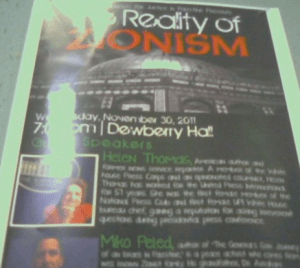
A few months in to my time at Mason, I came across this flyer on campus:
therealityof

How, exactly, will the “Reality of Zionism” be portrayed by Helen Thomas (who said that Jews should “go back to Germany”)? How, exactly, will the “Reality of Zionism” be portrayed by Miko Peled, a pro-“Palestine” activist?  Curious, I attended this event. The title was entirely misleading. There were no facts about the reality of Zionism included in the event. Instead, smears about Israel were spread, entirely unchecked. For a university to allow this event, without any events with a counterargument, just shows how academia is definitely not the marketplace of ideas. Academia has become nothing more than brainwashed propaganda being regurgitated by the masses.

A few months later, I received an e-mail from the university notifying me of an upcoming event:

StudentsforJusticeHolocaust

The first thing to notice is that this e-mail about “Arab-Jewish Relations Prior to the State of Israel” was sent out on April 19th, 2012. What else was April 19th, 2012?

HolocaustRemembranceDay

The second piece of pertinent information is that the anti-Israel event, hosted by “Students for Justice in ‘Palestine’”, was scheduled for April 25th, 2012. What else was April 25th, 2012?

israelindependencedate

It’s possible that George Mason University made a horrible error in the day in which it sent out this e-mail. It’s possible that George Mason University made a horrible error in the day in which the event was scheduled. However, not only did George Mason University send out its e-mail about “Arab-Jewish Relations Prior to the State of Israel” on Holocaust Remembrance Day, the anti-Israel event was scheduled for Yom HaAtzmaut, Israel’s Independence Day. Oops! This is more than just two awful coincidences: this was nefarious intent. Pro-“Palestine” activists are not known for playing nice. One needs to look no further than who was invited to the event, an anti-Israel event being held on Israeli Independence Day: Rabbi Dovid Weiss. Rabbi Weiss is best known for heading Neturei Karta, or what is colloquially known as “Rabbis Against Zionism”. Of course, this would be an incredibly unbiased “discussion” of the facts…

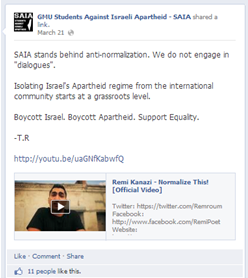
Lately, George Mason University has created a few new student groups. Not only is there “Students for Justice in ‘Palestine’”, now there is also “Students Against Israeli Apartheid”. Seems pretty redundant, huh? At the same time, George Mason University required the prospective Tea Party group and Constitutionalist Conservatives organizations to prove how they were different than the College Republicans, before the groups eventually collapsed under the bureaucratic requirements to start a recognized organization.

Even the “entirely apolitical” “Muslims Without Borders” has started participating in the “Palestine” dialogue:

muslimswithout

This advertisement is extremely disconcerting. It is an event in support of  “Palestine”, soliciting donations, but there is absolutely no specification about where the money from the fundraiser is going. It is extremely likely that the money being shoveled in to the “Palestinian” cause is going to fund terrorist activists. George Mason University allowed for this event to be held on campus, with its seal of approval. George Mason University also funded the event asking for money to go to “Palestine.”

At least Muslims Without Borders seems to want to further their cause (whatever that may be—caliphate, perhaps). Students Against Israeli Apartheid, however, seems to have resorted to profanity:

studentsagainst1

As well as literally stating they do not want a dialogue:
studentsagainst2

Currently, the university is covered in propaganda for “Islam Awareness Week.” Yes, my school is actually attempting to make people aware that Islam exists. George Mason University has an extremely large Muslim student body; however, I guess no one is aware that Islam exists. Funny, since this school is right near the Pentagon. I thought everyone was made aware of Islam’s existence on 9/11.

Islam Awareness Week happens to be during International Week this year. This means that “Palestine” was participating in the flag-waving:

duckface

I think the duck lips and peace sign really say it all…

The International Week is supposed to be a welcoming environment for the gigantic international student population on campus, yet the people from Israel received boos and snide remarks. The students from Israel have absolutely nothing to do with the policies of the Israeli government. “Palestine”, on the other-hand, received thunderous applause. Alas, George Mason University prides itself on acceptance of diversity.

Since the weather has been improving these past few days, people have taken to the campus center to promote their causes.  The other day, I was standing with a friend, Chris Pavlovych, when we were approached by a woman handing out these flyers:

campuszionism

These flyers are from an approved student organization, funded with tax-payer dollars, at George Mason University. Upon looking at me, the woman with the flyers immediately ripped the flyer out of my hands and gave it to my friend. A few moments later, another person approached Chris to give him yet another copy of the same flyer. When he offered a rebuttal in defense of Israel, the response was, “Oh, you’re one of those people.”

Perhaps the most important symbol to prove just how strongly George Mason University promotes Islam is Zachary Chesser. Before coming to Mason, Zachary was described by his peers as being a normal kid. At Mason, he became radicalized. He’s best known for being the individual who threatened the creators of “South Park” for using an image of Muhammad.

George Mason would be rolling over in his grave if he knew the university which bears his name was using tax dollars to support Islam. In fact, the issue of tax dollar funding is not localized to Virginia. Since Mason accepts federal support, federal money, and federal student loans, every single tax paying American is currently funding the activities at George Mason University. The left loves to cry “separation of church and state”, but there is never an issue of “mosque and state.” Anyone who opposes the use of their own money being funneled into pro-Islam activities is an “Islamophobe.”

Edit, 7:05 PM: Since publishing this post, I have remembered that my school has a Muslim basketball team. Flyers were distributed, and I took a photograph of one of them. I am currently trying to locate the photo. There are also dining services on campus that are Halal.

Ban Coercion Instead

News of school and mall shootings has understandably set many on edge and led to calls for policies on both sides of the equation. While those opposed to the ownership of certain types of firearms have come up with their share of coercive and unreasonable policies, those in favor of gun ownership have come up with equally coercive and unreasonable policies of their own.

Recently on girlsjustwannahaveguns.com, a columnist wrote about why legislators should work to ban gun-free zones, not only on the public level (which is understandable and even laudable), but on the private level, too.

Girls Just Wanna Have Guns is ostensibly a right of center and conservative page, given the reverence that the columnists have for God, firearms, and America.

The author suggests banning gun-free zones to prevent future shootings from happening due to the deterrence factor of private citizens being legally armed. While this has basis in fact, it has no basis in what should be a cornerstone of conservatism, at least on the domestic level, a respect for private property rights and for the owner of a property to determine what is done with their land without having the heavy hand of government interfere.

Furthermore, my interest is piqued by this quote, which seems contradictory given the author’s thesis:

“In panic we suggest extremes like banning firearms, which would without doubt, be as effective as the current ban on drugs, or the previous ban on alcohol.”

In panic, the author is suggesting an extreme: banning the right of businessmen to have at least one choice given the multitude of codes and regulations legislating what a business must and mustn’t do on national, state, and local levels. Given that the current war on drugs and Prohibition weren’t effective even with state-initiated violence and the risk of prison time, would the ban on gun-free zones even be effective? In a sense, the author is both arguing for a government prohibition while citing how government prohibitions don’t work.

While not on the same par as eminent domain, the same course of logic that supporters of eminent domain resort to is present in the argument for banning even a privately enforced gun free zone.

Gun free zones on the private level should not be banned; there are certain ways to make the practice untenable, just as Chick-Fil-A’s support of groups seen as intolerant was made untenable. Instead of urging for a ban on gun free zones, the author should instead boycott and urge her readers to demonstrate against businesses that have such policies. The NRA, an organization that has been cited in changing the balance of power in the halls of The Capitol, could do much to change the policies of businesses if they put enough time and money into such a campaign.

I stand for markets, not coercion. While I’m a gun owner, I still recognize the right that an individual business owner has to voluntary association. I avoid businesses that have gun free zone policies. I don’t seek to ask someone else to intervene with force on my behalf, just as the author shouldn’t do. You can’t stop one form of violence by initiating another form of violence, even if it’s on the governmental level. Don’t ban gun free zones, ban government coercion.

no_guns_allowed_4

Idiot Box?

How many times do you see some status posted or image shared that dismisses television as a waste of time or a killer of brain cells? I disagree with that assessment.

While I prefer reading books, this is not to suggest that certain programming doesn’t expand the mind. There is certain value to many programs, if for no other reason than the escapism that certain ones, like Dexter, The Following, or Revolution, can bring to those of us who find our lives consumed by political work. The aforementioned shows not only function as a means of escapism, but also raise some important points. Dexter is a show that reminds me how superficial I can sometimes be, especially in regards to my interactions around those who lack interest or aren’t involved in the same things I am – whether it be hunting, fishing, shooting, or politics. The Following takes the viewer into the mind of a megalomaniac cult leader and showcases the interpersonal relationships of those he lives with and those who are in pursuit of him. Revolution is a Dystopian show that takes place in  post-collapse United States.

These shows provoke my mind and conscience, and clearly are not created with the goals of leeching my mind or making me subservient. These shows also touch us on the human level- with Dexter, as libertarians, we’re almost given satisfaction with the actions he takes against the murderers, child molesters, and rapists the state has let slip through the cracks. With The Following, we’re reminded how easily the human mind can be manipulated- whether they be a cult leader or politician. With Revolution, we’re reminded of what is possible in the event of a collapse and must reflect on the levels of our preparedness or the moral decisions we would make to defend or feed or families in that case.

Programs like these ask moral questions of us with their content. They are not meaningless. In Dexter, Dexter Morgan struggles with his nature, knowing that no one else would accept his affinity for killing. In some episodes, he is seen as a folk hero, very similar to the sentiments held by Agent Smecker towards the McManus brothers in The Boondock Saints. We find ourselves asking if his extralegal actions are justified. As a libertarian who understands that the state-enforced monopoly on courts lets many violent criminals free and incarcerates too many nonviolent offenders, I find his actions justifiable, even if theatrical in nature. The Following can be seen as questioning how powerful the cult of personality is and hopefully lead even those of a non-libertarian persuasion to evaluate who they follow or the actions they take for another person or entity. In Revolution, we are shown what would actually happen if only one group had modern firearms; this can be seen as a question to society as to how much they want the government (or any other singular group) to have a monopoly on certain types of weapons.

They have also been accepted by the public as shown by the fact that they are still on air. Millions of individuals – myself included – have made the rational decision to set aside an hour of our weeks to view these shows and the advertising that comes along with them. It is not as if they have been subsidized or created by bureaucrats; they have risen from the ground up. Given the point of views held therein or even those that are implied, they’re by no means a conspiracy to make us dumber.

For being an idiot box, I’ve certainly learned a lot from my time spent viewing these shows. These shows have given me time to get bound up in a story that doesn’t have to do with budgets, taxes, social issues, or the daily political grind. These shows have made my mind tick and consider various things. Last but not least, these shows have made me question things- whether it be the law, leadership, or the monopoly of force. Granted, all of these things part and parcel have something to do with politics yet these shows let me effectively consider these concepts in a fictional world with no external implications – a sort of run-through to speak. While some programming can dumb us down, we must emphasize shows that can effectively expand the mind, like the ones contained herein.

It Was My Idea First!

It’s My Idea!

The nature of property and what constitutes rightful claims to property defines many aspects of life – cultures with differing views on property will most certainly vary widely in belief systems, norms, social institutions, and so on. When it comes to Libertarianism, the guiding notion of what constitutes property is that property is the extension of the self and that one has a rightful claim to themselves. Libertarian views on property are quite similar to Locke’s theory of property in that physical property is created by mixing labor with land/resources (which in turn, can be bought and sold, including one’s own labor.) But, generally, Libertarians refute the notion that ideas and thoughts, otherwise known as ‘Intellectual Property’, are valid, and therefore no one has a rightful claim to such property.

The form of intellectual property I would like to discuss and defend is not the form of intellectual property that is upheld by the state and its laws; rather, the intellectual property I will be discussing deals with the literal ownership of one’s own ideas, regardless of the existence of a state or Intellectual Property laws.

Every action that someone engages in is a result of an idea or thought – a will to accomplish something, the drive to move or build, fix or destroy. No one could mix their labor with land or engage in trade, or do anything, for that matter,without their own thoughts and calculations guiding them and causing their physical body to act in accordance with their will. If one accepts the idea of property, in its general form, then they must then derive the root of physical property – and how physical property comes about.

All physical property comes about through the manifestation of ideas. Simply put, one must own their own ideas in order to own anything that those ideas accomplish or create. An idea or thought is what brings you to the market, what guides transactions, what brings about trade-and at the very bottom of all of this, creation itself. Creation of any physical property must come about through intangible thought processes. If no one owns their own thought processes, then who/what does?

For example, let us look at the case of a chair. For simplicity’s sake, this chair was fashioned with materials all owned and created by the owner, without anyone else mixing their labor with the chair or the resources. The chair, with its stiles and brackets, were all shaped by the labor of the owner. The wood, being necessary for the completion of the chair, was chopped down by the owner, whose sole intent was to create the chair. This chair did not come into existence on its own, nor did the tree shape itself into the chair without the labor of the owner; yet, the owner’s labor did not act on its own accord. The owner, for whatever reason, thought it necessary to have the chair, to chop down the tree, to whittle down the wood and to carve it into curves and fashion a seat for himself. The owner of the chair owned the idea to create the chair, and similarly owned the means (his body) to make the chair. Even if we change this scenario and say that another person told him to make the chair, then we can logically assume that the other person owned the idea to make the chair, despite the action being taken through the other. The idea must originate somewhere; moreover, the originator has the ability to hold onto the idea, save risking that idea being acted upon by someone else who thinks of the same or similar idea. When we look at the existence of the chair in reverse chronological order, then we can derive the nature of intellectual property and how all physical property is a result of the latter.

This form of intellectual property is not the form that (some) libertarians have come to abhor. The form of intellectual property that exists today comes is more often than not in the form of copyrights, patents, regulations, laws, etc. (many of the things that Libertarians dislike.) Therefore, it is only natural for Libertarians to dismiss this type of intellectual property without distinguishing this form of intellectual property from true intellectual property.

True intellectual property extends only insofar as the originator’s ability to act upon their idea in a timely fashion or efficient manner. Here enters what economists generally refer to as “the first to market.” If one is the first to market with an idea, then they are the ones who will benefit the most, and be accredited with the idea. Note, this DOES NOT MEAN that the state has a right to enforce a perpetual first-to-the-market condition, which is typically enforced by patents and the like. The originator of the idea has the ability to cover investment and start-up costs by being the first to market. The risk of losing this natural grace period should be enough to drive the originator to get to the market first and make enough on the idea or product as to cover the costs of putting the idea forward. After this grace period, however, the idea/product is obviously likened to imitation; however, this is a good thing. From an egotistical standpoint, the originator had earned their keep and has a legitimate claim to the original idea. From an altruistic viewpoint, the originator has created something that can be enjoyed by all, and be openly traded in the market. In this double-instance, all are satisfied, and there was no impediment to innovation nor was there any dead-weight loss in the economy on the whole.

Again, I want to clarify that Intellectual Property is obviously open to being copied, imitated, ‘stolen’, and so on. No property is permanent, nor do you have any say in property once it is sold to another person. Once the idea is manifested into something physical, buyers have the ability to acquire the product and make copies of it, or re-sell it, or give it away for free (in the free market, or freer markets.) All physical property is subject to this, wherein such property is derived from thoughts and ideas.

What happens with state intervention in this scenario is, essentially, the establishment of a monopoly. The originator would be able to extend this grace period of higher profits (and higher costs for the consumer) so long as the state enforces their monopoly. It is important to recognize that, in both cases, the originator does indeed own the idea for whatever product they set forth-the difference in the former cases opposed to the latter is that the state ensures that the originator can hold the price high for longer than what it would naturally be. This is the difference that many anti-IP Libertarians fail to see. The idea still originated with the person, and they still were the first to market. The latter case is the undesirable one, the case that unfairly utilizes force to upset the natural course of events, a course of events that would otherwise been beneficial to all. This is an important distinction that must be made. In both cases, Intellectual Property still exists; however, the state manipulates and distorts its true form. Originators of ideas do not have the sole claim to it for all of eternity, just as a land-owner would not own the land for all of time. In its true essence, Intellectual Property is simply the recognition that an originator has developed a unique and original idea; it is NOT the establishment of a monopoly on the idea.